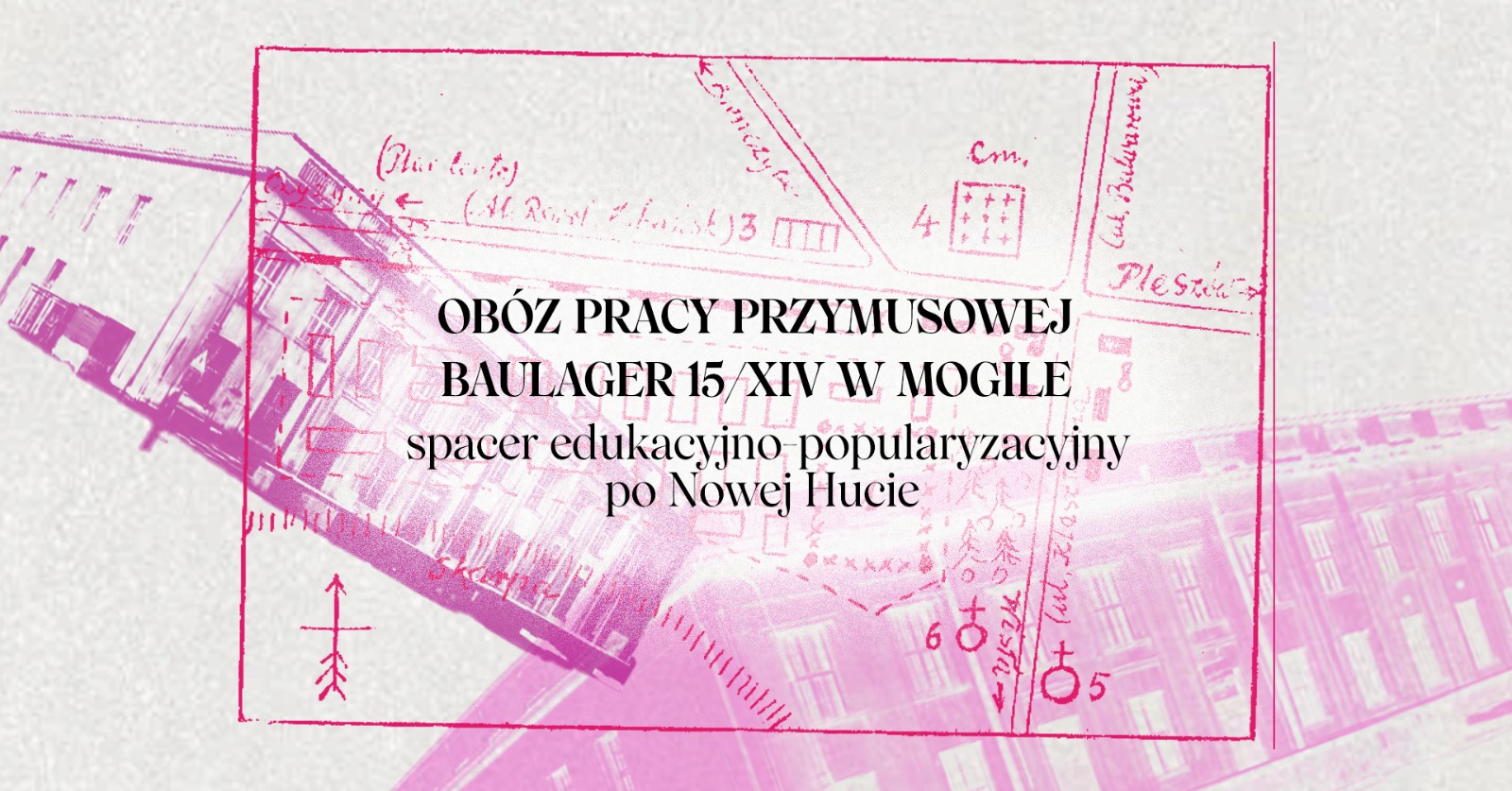
A sound walk through the site of the former Baulager 15/XIV construction camp in Mogiła (today’s Nowa Huta), carried out in collaboration with artist Ludomir Franczak and the local community.
Hidden behind the unusual name Baulager 15/XIV (German: Baulager, English: construction camp, Polish: zaplecze budowy/skład budowlany) is one of two subcategories of Nazi forced-labour camps. The term referred to sites where prisoners were forced to carry out construction work, archaeological excavations, and the removal of rubble. Mortality rates were higher here than in the second subtype – German: Fabriklager, English: factory camp, Polish: obóz fabryczny – which referred to the forced labour of prisoners in armaments production.
The number 15 most likely indicates the number assigned to a specific detention site within a particular camp system/network, while the Roman numeral XIV may refer to an administrative district within the German system, encompassing the area around Kraków (during the war, Mogiła belonged to the Kraków District, an administrative unit of the General Government).
Baulager 15/XIV was most probably established in the spring of 1942 and covered an area of approximately 5–10 hectares. To the south, the site was bounded by an escarpment; to the north, by Mogiła railway station and the road from Czyżyny to Pleszew (towards Nowe Brzesko). Today, this corresponds to the area of the Centrum E, Na Skarpie, Młodości (partially), and Ogrodowe (some buildings) housing estates.
The site was enclosed by a two-metre-high wire-mesh fence topped with barbed wire. In addition to a railway siding serving the camp, the immediate vicinity included a kitchen preparing meals for the forced labourers and a cinema called Pod wesołą łopatą (Under the Cheerful Shovel), where films were screened for German soldiers and prisoners. Local residents were also admitted to the screenings for prisoners.
The victims were predominantly Soviet, Hungarian, Romanian, and Yugoslav prisoners of war. The camp also held Jewish male and female prisoners from Poland and Hungary, as well as Polish forced labourers and non-Jewish Polish prisoners from KL Plaszow. We know the names of only a few people associated with the history of this place: sisters Rena and Ernestyna Meisels from Kraków, a Kraków Jew named Koch, and the non-Jewish Polish women Zającowa and Guzikowa from Zakopane.
The camp was liquidated in January 1945; the fate of the prisoners of war who had been held there remains unknown. The demolition of the barracks continued between 1945 and 1949. In 1949, construction of Nowa Huta began.
The project of creating a sound walk through the site of the former Baulager 15/XIV construction camp in Mogiła (today: Nowa Huta) would not be possible without the involvement of the local community, which for years has been making efforts to commemorate the history of this place and its victims – by establishing the Facebook group NH Tablica Pamięci, submitting a civic budget proposal, and undertaking other grassroots activist initiatives (collecting archival materials and oral testimonies, talking to residents and public institutions, and sharing vernacular knowledge with others).
Our first joint project – Memory Patterns (2024) – was dedicated to the Meisels sisters from Kraków: Ernestyna, Paulina, Rena, Gizela, and Maryla. Ernestyna and Rena were prisoners of Baulager 15/XIV in Mogiła, as well as KL Plaszow, KL Auschwitz, and KL Stutthof, where all traces of them disappeared.
Drawing on the strong tailoring traditions present in the Meisels family, as well as the feminist potential of craftivist art, together with New Huta-based institutions – Dom Utopii – International Empathy Centre and the Norwid Cultural Centre – we organized an event consisting of a historical lecture on the history of the camp, an open discussion on the role of local activism, and embroidery workshops with artist Ewa Cieniak and the Miejskie Hafciarki from ARTzona. These were followed by an exhibition of portraits of the Meisels sisters created by the workshop participants, presented there shortly afterwards.
At the same time, we remained in contact with the management of the Museum of Nowa Huta, located within the former camp site. We sought to support the community gathered around the NH Tablica Pamięci group and to obtain information about the possibility of installing a commemorative plaque on the building’s façade. This proved impossible due to planned renovation works, which began in 2025 and will continue until 2028.
The Museum of Nowa Huta plans to present the history of Baulager 15/XIV as part of a future permanent exhibition (an outdoor exhibition was presented in 2022 and made available online). It also offers thematic historical walks and, in 2025, conducted public consultations on ideas for potential future commemorations of the camp (the report is available here).
This transitional period – the renovation of the building, the conceptualisation of the permanent exhibition, and the development of a commemoration concept – became an impulse for us to continue grassroots, non-institutional activities focused on restoring the memory of this little-known episode in the history of present-day Nowa Huta. Our project is conceived as complementary to the existing and future museum offering, rather than as a competing initiative.
The sound walk will provide a permanent, digital, and universally accessible form of commemoration, modeled on similar walks we have created at the site of the former KL Plaszow in Kraków (In This Place) and in Saska Kępa and Grochów in Warsaw (Hiding and Rescuing: Saska Kępa and Grochów during the Holocaust).
We have once again invited artist Ludomir Franczak to collaborate with us; he was a co-creator of the In This Place project. Our point of departure is the process of transformation that this area has undergone over the years, leading to the erasure of the memory of its Nazi history, as well as the role of the local community and vernacular knowledge in recovering that memory. Where possible, we will also seek to incorporate other perspectives into the soundscape.
The project will premiere in autumn 2026.
For those interested in the history of Baulager 15/XIV and Nowa Huta—from local, scholarly, vernacular, or commemorative perspectives—as well as in local memory initiatives over the years, we also recommend consulting the following sources and initiatives:
- Nowohucka Kronika Filmowa No. 682, Ośrodek Kultury Norwida, 13 August 2024, https://www.youtube.com/watch?v=8mEc8GP3bQI.
- Renata Radłowska, Niemiecki obóz pracy przymusowej na terenie obecnej Nowej Huty. Historia prawie nieznana [German Forced Labour Camp in Present-Day Nowa Huta: A Little-Known History], Gazeta Wyborcza (Kraków), 26 April 2021, https://krakow.wyborcza.pl/krakow/7,44425,27016719,niemiecki-oboz-pracy-przymusowej-w-nowej-hucie-historia-prawie.html.
- Renata Radłowska, Kobietom w ucieczce z obozu pracy pomogła rodzina Feretów z Mogiły. Kto zna ich losy? [The Feret Family from Mogiła Helped Women Escape from the Labour Camp. Who Knows What Happened to Them?], Gazeta Wyborcza (Kraków), 18 May 2021, https://krakow.wyborcza.pl/krakow/7,44425,27095622,wojenna-historia-z-nowej-huty-bedzie-miala-ciag-dalszy.html.
- Poprzez pamięć, a nie zapomnienie [Through Memory, Not Forgetting], Kraków Civic Budget, 2022, https://budzet.krakow.pl/projekty2021/4130-poprzez-pamiec–a-nie-zapomnienie-.html.
- NOWA ODSŁONA „MIASTA IDEALNEGO”: „Baulager” – oprowadzanie z Grzegorzem Jeżowskim [A NEW TAKE ON THE “IDEAL CITY”: “Baulager” – A Guided Tour with Grzegorz Jeżowski], Dom Utopii – International Empathy Centre, 28 November 2024, https://domutopii.pl/event/nowa-odslona-miasta-idealnego-baulager-oprowadzanie-z-grzegorzem-jezowskim/.
- Stanisław Pater, Nad ujściem Dłubni do Wisły: walka i męczeństwo podczas okupacji niemieckiej na terenie obecnej Nowej Huty w latach 1939 do 1945 [At the Mouth of the Dłubnia River into the Vistula: Struggle and Martyrdom during the German Occupation in Present-Day Nowa Huta, 1939–1945], Cywilna Spółka Wydaw. Książek Pamiątkowych, Kraków, 1989.
- Czas zatrzymany 3. Nie tylko o szkole. Tom 1 [Time Stopped 3. Not Only About School, Vol. 1], ed. Adam Gryczyński, Nowohuckie Centrum Kultury, Kraków, 2019.
- Tomasz Owoc, Jeńcy wojenni w okupowanym Krakowie 1939–1945 [Prisoners of War in Occupied Kraków, 1939–1945], Muzeum Historyczne Miasta Krakowa, Kraków.
- Czesław Pilichowski, Obozy hitlerowskie na ziemiach polskich 1939–1945 [Nazi Camps in the Polish Lands, 1939–1945], PWN, Warsaw, 1979.
- Remigiusz Kasprzycki, Rakowice-Czyżyny w latach 1921–1955. Krakowskie Lotnictwo w Służbie Wojskowej i Cywilnej [Rakowice-Czyżyny, 1921–1955: Kraków Aviation in Military and Civil Service], Wydawnictwo Księgarnia Akademicka, Kraków, 2010.
- Karin Orth, “The Genesis and Structure of the National Socialist Concentration Camps,” in The United States Holocaust Memorial Museum Encyclopedia of Camps and Ghettos, 1933–1945, Vol. 1: Early Camps, Youth Camps, and Concentration Camps and Subcamps under the SS-Business Administration Main Office (WVHA), Part A, ed. Geoffrey P. Megargee, Indiana University Press & USHMM, Bloomington, 2009.
- Głos Nowohucki (1999/50, 2004/21, 2004/29, 2004/52, 2010/50, 2024/8).
- Głos Nowej Huty (1969/2).
- Zanim powstała Nowa Huta.
We would like to thank, among others, the following for their help in making the project possible: Zuzanna Bednorz, Dariusz Grochal, Katarzyna Kobylarczyk Kułakowska (The C. K. Norwid Culture Centre), Agnieszka Nieradko (The Rabbinical Commission for Cemeteries in Poland / Office of the Chief Rabbi of Poland), Paweł Szapiro, Małgorzata Szymczyk-Karnasiewicz (Utopia House – International Empathy Centre), Grażyna Olewniczak, Tomasz Owoc (Museum of Metallurgy in Chorzów), Tomasz Talerzak (Utopia House – International Empathy Centre), Karolina Żłobecka (Nowa Huta Museum).
Funding
Co-financed by the Minister of Culture and National Heritage under the “Sites of Memory and Permanent Memorials in Poland 2026” programme.